How Stories Shape Reactions: Separate an Event from Its Possible Meanings
A “story” here means the explanation or meaning you add to an event. It may be accurate, incomplete or mistaken. Separate what happened from what you think it means, then consider what information or action is needed. You do not have to replace every difficult thought with a positive one.
Revised
An event and an explanation are different information
Suppose a shared document has changed. “The introduction was edited” describes an event you can check. “They wanted to undermine my contribution” explains an intention. The edit alone does not establish that explanation, even if it brings anger or disappointment.
There may be other possibilities: the editor followed a new requirement, misunderstood the brief or made an unauthorised change. Listing them does not establish which is true. It creates a more precise question: what changed, who agreed to it and what instruction applies?
The NHS thought-reframing guidance describes links between thoughts, feelings and behaviour and suggests examining evidence and alternatives. This page uses that general distinction in original everyday examples. It does not reproduce the full CBT process or determine the cause of a reaction.
Compare interpretations without pretending they are facts
| Same known event | Possible interpretation | A response to consider |
|---|---|---|
| The shared introduction was edited. | “My contribution was deliberately dismissed.” | Check the edit history, relevant agreement and the actual concern before making a claim about intention. |
| The shared introduction was edited. | “The requirements may have changed.” | Ask which requirement informed the change; do not assume the edit was authorised. |
| The shared introduction was edited. | “There may have been a misunderstanding.” | Clarify the intended scope and whether the earlier wording is still needed. |
Each interpretation can make a different response seem urgent or useful. That does not mean your reaction is completely caused by a single thought, or that changing the wording will automatically change a feeling. Context, actual consequences and other conditions still matter.
Keep the response attached to a question you can check. An available edit record can establish what changed; it may not establish motive. An actual agreement can establish scope; it does not necessarily reveal how everyone felt.
Ask what supports the explanation and what is missing
Use three lines: known event, interpretation and information needed. An interpretation that sounds confident may still contain unknowns. “They never listen” is broader than “In this meeting, they continued after I asked to finish.” A documented pattern requires actual examples, rather than repeating the broad phrase.
Check both evidence and alternatives fairly. Do not collect only details that confirm the first explanation, but do not manufacture a pleasant story to dismiss a real problem. If the record shows an insulting statement or a breached agreement, that information stays relevant.
“I do not know why the change was made” can be a complete interim answer. The next step might be a factual clarification, an appropriate work process, a boundary or support. You are not obliged to ask the person directly when contact would be inappropriate or unsafe.
Keep the feeling and responsibility in the record
You may feel hurt before you know the explanation. The uncertainty does not make the feeling unreal or require you to justify it away. Conversely, a feeling does not establish another person’s intentions. Record both parts in wording you can understand.
If you reacted sharply to the edit, review what you actually said or did. A mistaken explanation can inform a correction, but it does not erase the action’s effect. “I accused you before checking the instruction” acknowledges a particular conduct; it does not require a whole-person judgment.
For separating experience categories, use the thoughts, feelings, urges and actions worksheet. For reviewing a disagreement afterwards, use the conflict reaction review. The explanation here is not a paired listening protocol or a requirement to reconcile.
Try four interpretation checks
These situations are invented to practise the distinctions on this page. They are not reports of results or a test of a person.
A document changed and you felt hurt. Does the feeling prove the editor’s intention?
No. The feeling is your experience; the intention may remain unknown. Check the edit and relevant agreement while keeping the feeling visible.
A second explanation sounds kinder. Must it replace the first as the truth?
No. An alternative remains a possibility until there is support for it. The exercise does not require a positive interpretation.
There is accurate evidence of harmful conduct. Does this page ask you to call it “just a story”?
No. Keep the actual conduct and evidence. A warranted concern may require a boundary, formal process or appropriate support.
You acted on an unsupported assumption. Does identifying the thought remove the need for repair?
No. Review your actual conduct and its known effect. A specific correction or apology may be appropriate without claiming it guarantees reconciliation.
End with the question or action that remains
Record a feasible next choice rather than extending the list of possible motives forever. “Ask which requirement changed” is a question. “They will respect me after I explain” predicts an outcome you cannot guarantee.
The NHS notes that reframing is not compulsory and does not solve every real problem. You can leave a thought unresolved, return to an ordinary task, obtain information or use appropriate support. A useful distinction does not mean you must feel better by the end.
Stop a reflection that increases distress or becomes repeated checking. Do not use it to explain away intimidation, postpone necessary help or blame yourself for every reaction. This original record offers a practical language distinction, rather than treatment or a judgment about a relationship.
Use the original diagram and optional record
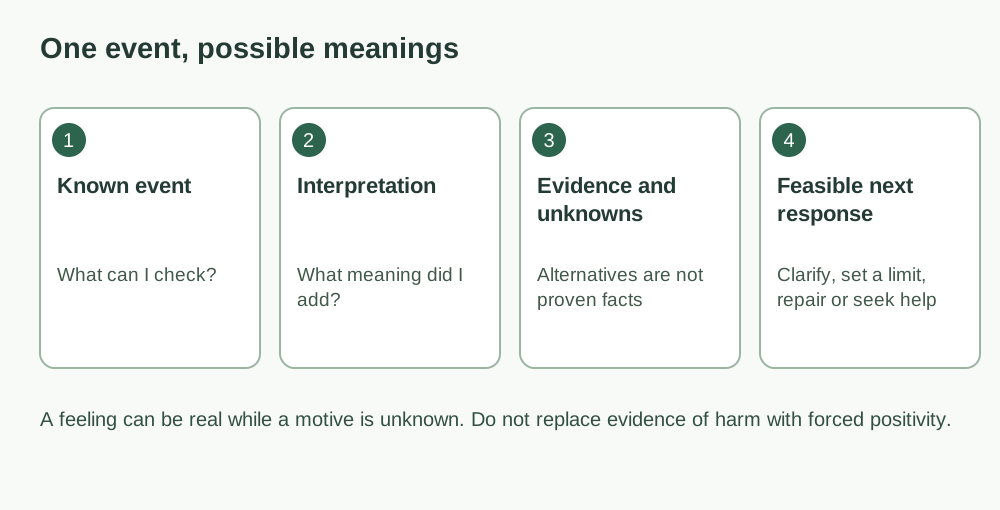
View or download the original diagram (SVG) · Download the editable record (TXT)
EVENT I CAN CHECK:
FIRST EXPLANATION / STORY I NOTICED:
FEELING, IF USEFUL:
EVIDENCE FOR THE EXPLANATION:
UNKNOWN INFORMATION:
ANOTHER POSSIBILITY, WITHOUT ASSUMING IT IS TRUE:
QUESTION / BOUNDARY / REPAIR / HELP / STOP:
ACTUAL ACTION / OUTCOME STILL UNKNOWN:
Sources and further reading
- NHS Every Mind Matters: Reframing unhelpful thoughts — Thoughts, feelings and behaviour can influence one another. Checking evidence and alternatives need not deny a real problem; changing every thought is not required. This guide does not reproduce a clinical CBT protocol.
- NHS: Mindfulness — Present-moment awareness, naming thoughts and feelings, gently returning attention, and the qualification that mindfulness may be unhelpful or make some people feel worse. This original exercise is not a mindfulness-based therapy.
- NIMH: Caring for Your Mental Health — Emotional and practical support, individual self-care choices and qualified help for severe or distressing persistent symptoms. Its US crisis contacts are not worldwide services.