Practical guide
Mindful Listening Practice: Noticing the Urge to Reply
Agree a small topic, notice when a reply starts forming, return to the communication and check one meaning. Finish with an observation and a voluntary next choice.
Notice the reply being prepared, then return to the speaker
You are listening to someone describe a small problem and begin arranging your own opening sentence: “That happened to me,” “You should…,” or “But that isn’t what I meant.” Noticing that preparation gives you a choice. You can return to what the person is saying, ask for a missed detail or wait until they finish before deciding what response is useful.
This practice is about noticing that moment. It does not ask you to have an empty mind, agree with everything or never speak. Thinking of a reply is normal, and it does not always mean you missed the person’s point. The useful question is whether you are still following them or have started rehearsing your turn instead.
NHS guidance on mindfulness describes noticing thoughts as mental events and bringing attention back when it wanders. Greater Good in Action’s Active Listening practice specifically advises avoiding mentally prepared rebuttals, paraphrasing and asking clarifying questions. The original paired exercise below combines those general ideas into a modest observation task; it is not a clinical treatment or a test of your relationship.
You will finish with one observation and, if useful, one adjustment for an ordinary conversation. You are not aiming for a score, a flawless performance or a guarantee that the other person feels understood.
Agree a low-pressure topic and a way to stop
Invite someone who wants to try it. Explain the purpose before starting: “Could we take a short turn each, so I can notice when I start preparing my reply? We can stop or change the topic.” Do not announce that you are testing whether they are a good listener, or use the exercise as a condition for being heard.
Choose an ordinary, low-stakes topic: one small part of the day, a hobby decision or an upcoming routine task. Each person decides what to share. Avoid making a first practice about an unresolved argument, a disclosure they feel obliged to make or a decision that needs an immediate answer. A person can decline the topic, the practice or the second turn.
Agree a comfortable length. For example, each speaker might have about 60–90 seconds followed by a short check of understanding. That is an optional size for this original exercise, not a researched dose or a minimum needed for benefit. You can shorten it, use an untimed turn or stop. Greater Good in Action describes a different practice of at least ten minutes, tried weekly; this card does not reproduce or validate that schedule.
Choose a communication setup that suits both people: face-to-face, a call, sign language or written exchange. Allow enough time to follow the person’s actual communication. Eye contact, a particular posture, eyes closed and focusing on breathing are not requirements of this worksheet. Reduce avoidable distractions without treating a gaze shift, movement or communication aid as proof of poor attention.
Agree a stop phrase such as “Let’s pause.” Keep the topic and any notes private according to both people’s wishes; do not record or share their words without agreement. The listener’s note can concern their own urge to reply rather than the speaker’s personal story.
Use five steps for one listening turn
Keep the observation small. You do not need to track every sensation or count every wandering thought while someone is speaking. Notice one sign that you have started rehearsing a response, then reconnect with the communication in front of you.
| Step | Speaker’s part | Listener’s part |
|---|---|---|
| 1. Speaker chooses a small topic | Describe only what you want to share; finish or pause when needed. | Follow the words or messages without composing a speech about yourself. |
| 2. Listener notices one cue | Continue in your normal communication style; no need to perform calm. | If a reply starts forming, briefly notice “planning” and return to the next point. |
| 3. Listener checks one meaning | Hear a short summary when you have finished the thought. | Try “I heard X, and the part that matters is Y. Have I understood?” |
| 4. Speaker corrects or confirms | Change the summary if it misses something, or say you want no summary. | Accept the correction; ask one clarification rather than defending your version. |
| 5. Both choose the next step | Say whether you want a response, a different topic or to stop. | Ask before advice or switching roles; do not assume the next turn is owed. |
At the end, a short summary gives the speaker an opportunity to correct your understanding. It does not certify that you understood everything or that their account is factually complete. Ask “Have I understood?” as a real question. If the answer is no, listen to what changes rather than explaining why your summary should count.
If you want to switch roles, ask whether the other person is willing. Choose a fresh small topic if that is easier. A fair conversation includes opportunities to speak, but a timed turn does not erase a power imbalance or oblige someone to continue. You can also end after one turn without calling the exercise incomplete.
Use an observation checklist without grading your attention
A cue is something you notice in this turn, not a diagnosis or a measure of empathy. You may notice wording in your thoughts, a ready-made solution or an impulse to take the floor. You do not need to label a body sensation, and the speaker cannot infer your inner attention from how still you look.
| Cue | Possible private wording | A workable return | Boundary |
|---|---|---|---|
| My opening sentence keeps being rehearsed | “When it’s my turn, I’ll say…” | Notice “planning”; follow the next point. | Do not try to ban all thoughts or count them throughout the turn. |
| A rebuttal is ready before the thought is finished | “That is wrong because…” | Let them complete the point; later clarify the fact or your disagreement. | Listening is not accepting an inaccurate claim as true. |
| I am choosing advice before knowing the need | “They should just…” | Return to what they are asking or describing. | An idea can wait; ask whether advice is wanted before offering it. |
| I am searching for my similar story | “This reminds me of my…” | Notice the comparison; stay with this person’s details. | Sharing later may be useful, but similarity does not establish the same experience. |
| I missed a word or a change in the topic | “I can guess what they mean.” | Ask for the missed part or clarification. | Guessing and presenting it as their meaning hides the gap. |
| I feel the pull only after interrupting | “I already began my answer.” | Acknowledge the interruption and give the floor back if they want it. | Noticing late is an observation, not proof of a bad personality. |
Choose one cue that actually occurred, or write “I did not notice one.” Do not invent a cue to finish the worksheet. If silently naming the urge itself becomes distracting, omit the label and simply return to the speaker. The point is useful attention, not a perfect sequence of inner instructions.
The thoughts, feelings, urges and actions worksheet helps distinguish wanting to interrupt from actually interrupting. You can notice an urge and choose a different action while still feeling it. An uncomfortable feeling does not have to disappear before you ask a clear question.
Return with a small clarification or repair
You do not need to disclose every thought. A short repair is useful when the speaker has been interrupted or when you missed something that affects your understanding. Describe your action and the gap, then let them choose whether to repeat or continue.
| Situation | Possible wording | Keep this limit |
|---|---|---|
| You missed part of the meaning | “I started planning my reply and missed that last part. Could you repeat it?” | Own the gap; do not make the person’s communication the problem. |
| Your summary is corrected | “Thanks. So the concern is the changed date, rather than the extra work. Is that closer?” | Use the correction; do not argue that both summaries are basically the same. |
| You already interrupted | “I interrupted. Please finish, if you want to.” | Give the floor back; avoid a long apology that takes more of the turn. |
| You have a possible solution | “Would you like ideas, or would it help to leave this as listening for now?” | Ask before advice; a preference is not permission for every later topic. |
| You disagree or need a boundary | “I understand that this is your view. I see that fact differently. Can we separate those points?” | Understanding does not require agreement, silence or abandoning a boundary. |
These are optional wording examples, not scripts the other person must accept. Use language that fits the relationship and the actual issue. A summary such as “You feel frustrated” should remain open to correction; it does not give you special knowledge of their feelings. Acknowledging their reported experience is different from endorsing every interpretation or requested action.
A clarification can happen during a turn if it is needed to follow the communication. Do not turn the optional timing into a rule against a necessary question, correction or safety boundary. If someone wants ordinary conversation rather than a listening exercise, that preference is enough to change the format.
Three fictional dialogues show what the check of meaning changes
These are original invented dialogues, not recordings, testimonials or tested examples. The private cue is included so you can see the choice before the spoken response; a real listener need not narrate their inner thoughts.
1. Advice arrives before the need is clear
Speaker: The schedule changed again, and I had already arranged my afternoon.
Listener’s private cue: I am drafting “just call the manager.”
Listener: I heard that the changed schedule disrupted your plan. Is that the main concern?
Speaker: Mostly I need the confirmed date. I am not asking you to fix it.
Listener: Understood. Would you like me to keep listening, or stop here?
The listener’s advice idea did not become an instruction. The speaker clarified the need; the dialogue makes no claim about an actual relationship or outcome.
2. A disagreement stays separate from understanding
Speaker: I thought you had said the meeting was tomorrow, so I did not prepare today.
Listener’s private cue: I want to prove that my message said today.
Listener: You planned around tomorrow and were caught unprepared today. Have I understood your concern?
Speaker: Yes. I also want us to check what the message actually said.
Listener: We can check it. I remember a different date, and we can separate that from how the change affected you.
The summary does not decide whose memory is accurate. Listening leaves room to verify the message and disagree about the fact.
3. An interruption is noticed after it happens
Speaker: The new route takes me past the library, which—
Listener: That is the route I used last year—sorry, I interrupted. Please finish, if you want to.
Speaker: I was going to say the library is closed on the day I go.
Listener: So the library stop may not work on that day. Is that what you wanted me to hear?
Speaker: Yes. I want to think about another day later.
The repair is short and lets the speaker finish. It does not require the listener to offer a substitute route or label themselves a poor listener.
A useful summary is revisable. The speaker might say “That isn’t what I meant” or decline to explain further. Those answers matter more than whether the listener’s wording sounds empathic. You can ask one clarification or end the exercise rather than repeat a polished summary until it is accepted.
Close the round with one observation and a next choice
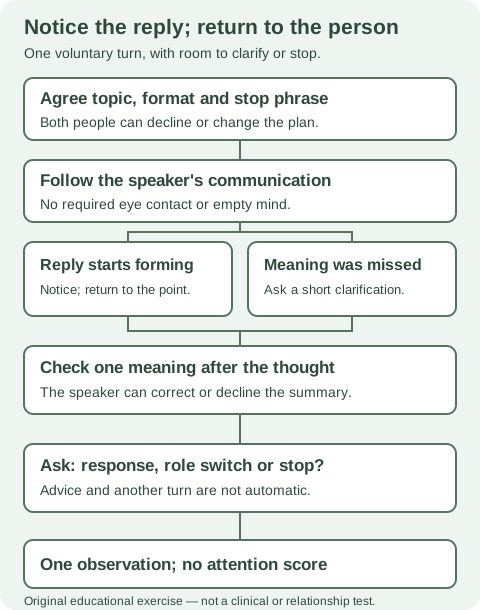
Ask each person whether they want to say anything about the format, then stop the formal exercise. One short listener observation is enough: “I began composing advice; I returned to your next sentence.” The speaker may say what was missed, ask for a change or prefer no review.
PAIRED LISTENING — BEFORE THE TURN
Both people want to try this, or pause/decline:
Topic the speaker is comfortable sharing:
Communication format and access needs:
Optional turn length; untimed is also possible:
Stop phrase and how either person can change the topic:
Notes or recording agreement; no recording is required:
Who is speaking first; role switch remains optional:
This is an observation exercise, not a relationship test.
AFTER THE TURN — MY LISTENING OBSERVATION
One cue I noticed, or “none noticed / unsure”:
What I actually did next, not what I intended:
Meaning I checked; keep the other person's private details out:
Correction or preference the speaker gave, if any:
Did I ask before advice or another turn?
One adjustment, shorter format, ordinary conversation or stop:
No attention score, diagnosis or guaranteed result follows.
Download the paired steps, observation checklist, dialogues and blank records. Use the record privately; this page does not submit your conversation. The journal privacy guide helps decide what to omit when an observation involves someone else.
A next choice can be a shorter turn, fewer distractions, a needed clarification or ordinary conversation without the exercise. If no useful cue appeared, leave the record uncertain rather than inventing an improvement. You do not need to repeat the round until someone confirms they feel heard.
NHS notes that mindfulness is not right for everyone and can make some people feel worse. If this format increases distress or makes the interaction harder, stop or choose another approach. Do not use a listening turn to postpone necessary help, tolerate intimidation or silence the person affected by a power imbalance. Greater Good in Action also cautions that listening and perspective-giving may matter differently depending on social power. Equal seconds do not make every situation equal.
The source page summarizes research about active listening, including reported understanding after initial conversations. We have read those summaries, not independently assessed the underlying studies. They do not establish that this shorter original worksheet treats a condition, prevents arguments or improves every relationship. For noticing an ordinary choice outside a paired exercise, use the choice-point practice.
Six checks about returning, clarification and consent
Try these original cases before opening the answer notes. They test how to use the worksheet, not anyone’s empathy, mental health or relationship quality.
Case 1
You notice that you are planning a rebuttal while the speaker is still describing the point. Does success require making the rebuttal thought disappear?
Show answer and explanation for case 1
No. Notice the preparation and return to what is being communicated.
The thought can remain while you choose to follow the next point. This exercise does not demand an empty mind or agreement with the speaker’s claim.
Case 2
Your partner corrects your summary. Should you explain why your summary was a good listening response before hearing the correction?
Show answer and explanation for case 2
Use the correction first and check the revised meaning.
A summary is a question about understanding, not a result the speaker must approve. Clarify the changed point rather than defending your wording.
Case 3
You think of a useful solution. Does waiting for the person to finish automatically give you permission to offer advice?
Show answer and explanation for case 3
No. Ask what kind of response they want.
Listening, clarification and advice are different choices. The speaker may want no solution, a different topic or to end the exercise.
Case 4
Someone shifts their gaze and uses a communication aid. Does that show they failed to pay mindful attention?
Show answer and explanation for case 4
No. Those features do not establish the person’s inner attention.
Choose a format that meets both people’s communication needs. Eye contact, stillness and a particular posture are not requirements or an attention score here.
Case 5
You interrupted before noticing the urge to reply. Is the whole round invalid?
Show answer and explanation for case 5
No. Make a brief repair and offer the floor back if they want it.
Noticing late can inform a next choice. Avoid a long self-critical explanation that takes another turn away from the speaker.
Case 6
Each person received ninety seconds. Does that make this a clinically validated exercise or erase a power imbalance?
Show answer and explanation for case 6
No. Equal timing establishes neither claim.
The length is an optional size for this original practice. It differs from the source’s protocol, and willingness, access needs, context and power still matter.
Sources and further reading
- NHS: Mindfulness (reviewed 17 August 2026)Noticing thoughts as mental events, returning attention and the qualification that mindfulness may be unhelpful or make some people feel worse. Clinical therapy recommendations do not validate this worksheet.
- Greater Good in Action: Active ListeningParaphrasing, clarifying, avoiding prepared rebuttals and unsolicited advice, taking turns and power-related limitations. Its at-least-ten-minute weekly practice and described research do not validate this shorter original exercise.