Practical guide
Values vs Goals: An Everyday Action-Sorting Worksheet
A value names a quality in how you want to act; a goal names an outcome; an action names what you do or say. Sort mixed statements, clarify vague labels and choose one feasible step while keeping duties, consent and uncertain outcomes visible.
Values describe the way; goals name an outcome
A value describes a quality you want to bring to your actions, such as being fair, curious or caring. A goal describes something you aim to finish or obtain, such as completing a course or arranging a visit. An action is a specific thing you do or say. The same action can support a value and also be a small goal you can complete.
For example, “be curious when learning” is a direction. “Finish the first lesson” is a goal. “Read one example and ask about the missing step” is an action. Finishing the lesson does not finish curiosity, and choosing curiosity does not complete the lesson for you.
Part 3 of WHO’s Doing What Matters in Times of Stress distinguishes how you want to be and treat people from what you are trying to obtain. It also discusses small feasible actions when a larger goal is unavailable. This article uses that distinction for original sorting examples and an editable record. It is not the WHO exercise, an assessment of your character or a tested treatment.
You can finish this worksheet with one clear direction, one possible outcome and one available action. You do not need to identify your life purpose, rank every value or decide what other people should care about.
Sort the wording before judging the person
| Category | Question it answers | Fictional example | Boundary |
|---|---|---|---|
| Value or direction | How you want to act toward yourself, others or the world | Be fair when sharing work | An ongoing quality; not a finished prize |
| Goal or outcome | Something you aim to complete or obtain | Agree the task allocation by Friday | Can have a completion point; may depend on others |
| Action | A specific thing you do or say | Ask what each person can realistically take on | May be one goal or a step toward a larger one |
| Needs more context | A broad label, feeling wish or mixed statement | Success; family; I want to feel confident | Clarify the meaning before choosing a category |
These are working categories for wording, not separate boxes for an entire life. “Call my friend tomorrow” describes an action and can be a small goal. Whether it expresses care depends on the situation and how the call happens. The sentence alone does not reveal a person’s motives or the friend’s wishes.
A goal does not need a deadline to be a goal. “Get a qualification” still names an outcome even before you have chosen a date. Adding a deadline can make a plan more specific, but it does not turn an outcome into a value.
Conversely, a familiar noun may be unclear. “Family” names people or a life area; it does not yet say how you want to act. You might mean caring, honesty, keeping a boundary or spending time together. Ask what the word means in this situation rather than treating one interpretation as the correct answer for everyone.
Keep mixed statements mixed until they are separated. “Be a caring sibling by arranging a visit this month” contains a direction and a goal. Write them on different lines so you can keep the direction while changing a plan that becomes impractical.
Separate a chosen direction from a wish or a demand
Try the wording “I want to act with…” and complete it with a quality you can describe in behavior. “I want to act with honesty when I explain what I know” is more usable than “I must become impressive.” Then name a small example of what that could look like and what it would not require.
A feeling wish has a different job. “I want to feel confident” describes a desired experience. It is understandable, but it does not yet specify how you want to act. You could ask a clear question, prepare one relevant example or acknowledge uncertainty while still feeling nervous. This is a way to clarify a choice, not a promise that the feeling will change.
“I want everyone to approve” also depends on other people’s responses. You can choose your wording and whether to ask for useful feedback; you cannot guarantee approval through a private worksheet. Keep the other person’s decision outside the box for your own action.
An expectation from somebody else is not automatically a value you have chosen, and a chosen value does not erase a real duty. “My supervisor requires this form” describes a requirement. You can clarify the requirement and consider how to handle it responsibly without pretending it is your life purpose. If the obligation or situation is unclear, information or a real conversation may be needed before reflection.
For more help finding a direction word, use the separate values clarification guide. You can leave a word provisional or undecided. The worksheet does not require proving which motives are pure or which people have better values.
Read six direction, goal and action examples
The examples below are invented to show different wording. They are not recommendations for a particular job, relationship, health condition or schedule. Use the actual permissions, duties, access needs and information in your situation.
| Situation | Possible direction | Possible goal | One action to consider |
|---|---|---|---|
| Learning | Be curious and careful | Finish the first lesson | Read one example; note the step I do not understand |
| Friendship | Be caring and respectful | Arrange a mutually welcome catch-up | Ask whether a call or another format suits them |
| Shared work | Be fair | Agree a feasible allocation | Ask what is already assigned and what each person can take on |
| Rest | Treat myself with care | End this work period when practical | Save the stopping point and check any actual duty first |
| Disagreement | Be honest and respectful | Clarify the disputed statement | State the part I know; ask about the part I missed |
| Application | Act carefully and responsibly | Obtain a place on a course | Check one actual requirement; keep the admission decision uncertain |
Notice the friendship example. A caring intention does not entitle you to a call, a reply or someone’s time. Asking about the format respects their choice. An unanswered invitation does not prove either that your care failed or that they have rejected the relationship.
The rest example also matters. Values are not a system that always chooses more work. Care can include rest, a limit or seeking help. At the same time, the worksheet cannot decide whether an actual responsibility permits ending a work period. Check the relevant conditions rather than using a value word as permission.
The application separates an action you can take from a decision made by others. A carefully checked application can still be unsuccessful. The outcome and the quality you aimed to bring are related questions, but they are not the same question.
When two values or responsibilities pull differently
You might want to be helpful to a colleague and protect time needed for an existing responsibility. Writing “helpful” at the top does not determine the answer. Identify what has actually been requested, what you have already agreed to, what time or access is available and who else is affected.
List two feasible options. You might offer a short clarification now, suggest a later time, explain that you cannot take on the task or ask which commitment should take priority. These are possibilities to check, not a script that guarantees a good response. There may be no option that satisfies every preference.
Describe the quality in how you act as well as what you choose. An honest limit and a considerate explanation can serve more than one direction. Agreeing immediately while concealing that you cannot deliver may conflict with the very helpfulness you intended.
Do not make “values alignment” a shortcut around consequences, consent or necessary expertise. A value word does not settle a legal obligation, workplace safety question, medical decision or another person’s rights. The next step may be obtaining the relevant information or support.
If the choice is still too broad, use the choice-point practice to identify the particular moment and two available actions. You can stop with an unresolved question instead of manufacturing certainty.
When a goal is blocked or has already fallen through
Start with what is known. “The course application was not accepted” names an outcome. “I am incapable of learning” is a much wider interpretation. You can notice that interpretation without recording it as a fact or requiring yourself to feel positive about the result.
WHO’s discussion uses an unavailable goal to show that a direction can still have other expressions. That does not make every alternative possible or mean you must find a benefit in adversity. Time, money, access, health, other people and the surrounding conditions can constrain what is available.
Ask whether the same goal still makes sense, whether information is missing, or whether a different goal could express the direction. If learning matters, a feasible next action could be reading an available explanation or checking whether another course exists. It can also be pausing the decision or seeking needed help. None of these proves that the original loss has been repaired.
For the emotional context of a missed outcome, use values after disappointment. Keep the feeling, the actual result, the chosen direction and the next option on separate lines. You do not have to turn disappointment into a lesson before choosing one practical step.
Use the direction, outcome and action record
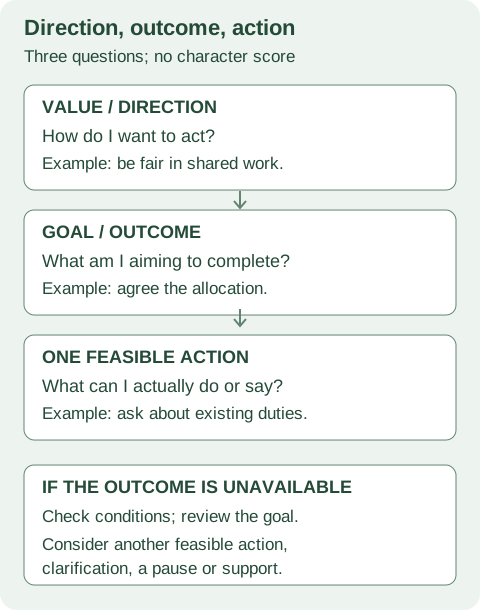
View the original sorting diagram, then use the editable sorting record. The diagram separates the questions; it does not calculate a score or decide your values.
SITUATION / ACTUAL CONDITIONS:
STATEMENT I AM SORTING:
CATEGORY OR MIXED / UNCERTAIN PART:
VALUE OR DIRECTION — HOW I WANT TO ACT:
GOAL OR OUTCOME — WHAT WOULD COUNT AS FINISHED:
ONE ACTION I CAN CONSIDER:
WHAT DEPENDS ON OTHER PEOPLE OR CONDITIONS:
DUTY / CONSENT / INFORMATION TO CHECK:
SMALLER OR ALTERNATIVE OPTION:
WHAT I ACTUALLY DID / WHAT REMAINS UNKNOWN:
Choose an ordinary statement rather than a private life history. For a note involving someone else, use a neutral reference and consider where the file or notebook is kept. The journal privacy guide addresses contents and storage. This worksheet does not require sharing your answers.
Review the action descriptively. “I asked what time would suit” records something done. “They will now appreciate me” predicts another person’s response. Keep unknown results unknown, and change the next plan if the actual conditions require it.
The NHS notes that mindfulness is not helpful or suitable for everyone and can make some people feel worse. Stop or change a reflection that increases distress or becomes another demand. Persistent difficulties affecting everyday life may need appropriate qualified support. This original record does not diagnose a condition, provide live help or establish an improvement in wellbeing.
Ten statements and situations to sort
Try these fictional cases before opening their explanations. They test the distinctions in the worksheet, not moral character, motivation, mental health or a relationship.
Case 1
“Be fair when allocating shared work.” Which category fits the wording?
Show answer and explanation for case 1
Value or direction.
It describes a quality in how work is shared, not a completed allocation. You still need the actual responsibilities and people’s input before choosing an action.
Case 2
“Agree the shared-task allocation by Friday.” Is the deadline what makes this a value?
Show answer and explanation for case 2
No. It is a goal or outcome.
An agreed allocation can have a completion point. A deadline makes timing specific but does not change an outcome into an ongoing quality.
Case 3
“Call my friend tomorrow.” Must this belong only in the action box?
Show answer and explanation for case 3
No. It is an action and can also be a small goal.
Completing a call is observable, but whether it expresses care depends on context and the other person’s wishes. Category overlap is allowed.
Case 4
“Family.” Does this identify exactly how you want to act?
Show answer and explanation for case 4
Not yet. More context is needed.
The noun names people or an area of life. Caring, honest, protective or boundaried behavior may mean different things in a particular situation.
Case 5
“I want to feel confident before asking a question.” Is confidence an action?
Show answer and explanation for case 5
The sentence names a desired feeling.
You can separately consider a clear question or preparation step. The worksheet does not promise confidence or require a feeling to change before every action.
Case 6
“Be caring by arranging a mutually welcome visit this month.” How should it be sorted?
Show answer and explanation for case 6
It combines a direction and a goal.
Separate caring from the proposed visit. If the visit becomes unavailable, the direction can remain while you review other feasible, welcome options.
Case 7
“Get a qualification.” Without a date, is it automatically a value?
Show answer and explanation for case 7
No. It still names an outcome.
A goal can be unfinished or unscheduled. The direction could involve learning carefully or curiosity, but that has not been specified by the qualification alone.
Case 8
“Everyone must approve of my explanation.” Can your action record guarantee this?
Show answer and explanation for case 8
No. Approval depends on other people.
You can consider clear, honest wording and relevant feedback. Their response remains outside what your own action can guarantee.
Case 9
A goal was unsuccessful. Does that establish that the chosen value was false or that you must feel positive?
Show answer and explanation for case 9
No. Keep the result, interpretation and direction separate.
Review actual conditions and available choices without making the outcome a verdict on your character or demanding a positive lesson.
Case 10
Being helpful seems to conflict with an existing duty. Must the worksheet choose “do more”?
Show answer and explanation for case 10
No. Check the duty, capacity and people affected.
A feasible clarification, honest limit or request about priorities may fit the situation. The value word itself cannot settle the responsibility.
Sources and further reading
- WHO: Doing What Matters in Times of Stress (2020), Part 3The guide distinguishes ways of acting from outcomes and discusses feasible small actions. Part 3, printed pages 79–98, informs the definitions; this original worksheet is not the WHO exercise or a tested intervention.
- NHS: Mindfulness (reviewed 17 August 2026)Noticing thoughts as mental events and the qualification that mindfulness may be unhelpful or make people feel worse. General context does not validate this sorting worksheet.