Attention After Scrolling: Review the Context and Choose a Stopping Cue
After a scrolling session, review what you opened it for, where the activity changed and what needs attention now. Use one concrete observation to choose a stopping cue or a different arrangement. The session does not diagnose your attention or establish that screens have damaged it.
Revised
Identify which kind of scrolling you mean
Scrolling a work document, looking for travel information, exchanging necessary messages and browsing an optional feed are different activities. Start with the one you actually used. A useful check does not label every screen interaction a distraction.
Write the purpose you remember: looking for one item, checking a message, taking a break, enjoying a feed or something uncertain. If you cannot remember, say so. You do not need to inspect your entire browsing history or produce an exact minute count to understand one transition.
Then describe the current situation. “The form is still open and the feed is in another tab” names an arrangement. “My brain has been ruined by scrolling” makes a claim this observation cannot establish. The question here is what the arrangement asks for next.
Compare purpose, transition and outcome
| Review line | Invented example | Useful distinction |
|---|---|---|
| Original purpose | “Check whether the event date was posted.” | A specific item, rather than a rule against using a phone. |
| Where it changed | “After finding the date, I opened another suggested post.” | The first optional continuation you actually remember. |
| Current task | “I still need to put the confirmed date in my calendar.” | A practical action, not a global concentration judgment. |
| Condition to notice | “The reminder was covered by the feed window.” | An observable setup detail, not a proved psychological cause. |
| Possible next cue | “After finding the date, return to the calendar.” | A cue tied to the original purpose. |
The example does not say that the suggested post caused an attention problem. You can note the order without proving a cause. Fatigue, stress, interruptions and an unclear next task may matter, but a brief journal cannot isolate them.
WHO describes stress as sometimes making concentration difficult and advises limiting news exposure if it increases stress. That is not a rule that all social media use is harmful or that a particular daily limit suits everyone. Keep the practical adjustment tied to your experience and responsibilities.
Choose a stopping cue that you can recognise
A cue can be an item found, a question answered, the end of a selected section or a normal external reminder. “When I have the date, open the calendar” identifies a transition. “Never scroll again” does not tell you what to do when you need information.
If the purpose is a chosen break, decide what would signal its end in the actual setting. That could be an existing reminder or a return point you can find. There is no researched break duration prescribed by this page. You can enjoy an optional activity without making every session a self-improvement exercise.
Change one condition where practical: leave an optional feed when the item is found, keep the unfinished document visible, or reduce an optional alert through your normal settings. Do not disable communication needed for care, work or access. Some conditions require an agreement or a different setup rather than more private discipline.
Distinguish a context review from returning to a task
If the original task still matters, the return-to-task card helps locate where you stopped and choose one concrete operation. That is a different task from reviewing the scrolling context. You do not need to complete both records before reopening a document.
If the next task is blocked, identify the missing information or arrangement. An attention practice cannot supply a required attachment or clarify an unconfirmed instruction. Rest, another responsibility or seeking help may be the appropriate next choice.
For an optional sensory pause rather than task resumption, use the post-scrolling attention practice. It does not promise to reset your brain, restore a measured amount of focus or make you ready to work.
Try four context checks
These situations are invented to practise the distinctions on this page. They are not reports of results or a test of a person.
You scrolled through instructions to find a required field. Is the scrolling itself evidence of distraction?
No. It may be part of the chosen task. Identify the actual purpose and outcome before labelling the activity.
A feed remained open after you found the item you wanted. What kind of cue could help?
Choose a visible transition tied to the item: after finding it, return to the calendar or document. This is an optional arrangement to try, not proof of a cause or guaranteed solution.
You feel tired after scrolling. Can the note conclude that scrolling caused all the tiredness?
No. Record the observation and relevant conditions without isolating a cause. A brief review cannot diagnose an attention or sleep problem.
The session included messages needed for a caring responsibility. Must all alerts be removed?
No. Keep necessary communication available. Adjust an optional interruption only when that fits the actual responsibilities.
Keep one useful observation
Use a short record if it helps: purpose, first remembered continuation, current task and one possible cue. No screen-time score, streak or confession is required. Keep the result descriptive: “I returned to the calendar” reports an action; “my focus is fixed” does not.
A personal note should not contain another person’s messages, account details or a browsing-history archive merely to make it complete. The privacy guide explains why the content and the location of a copy matter.
If the check becomes repeated self-criticism or distress, close it. Persistent concentration difficulties affecting usual activities may need an appropriate qualified professional. One scrolling entry cannot determine their cause or replace support.
Use the original diagram and optional record
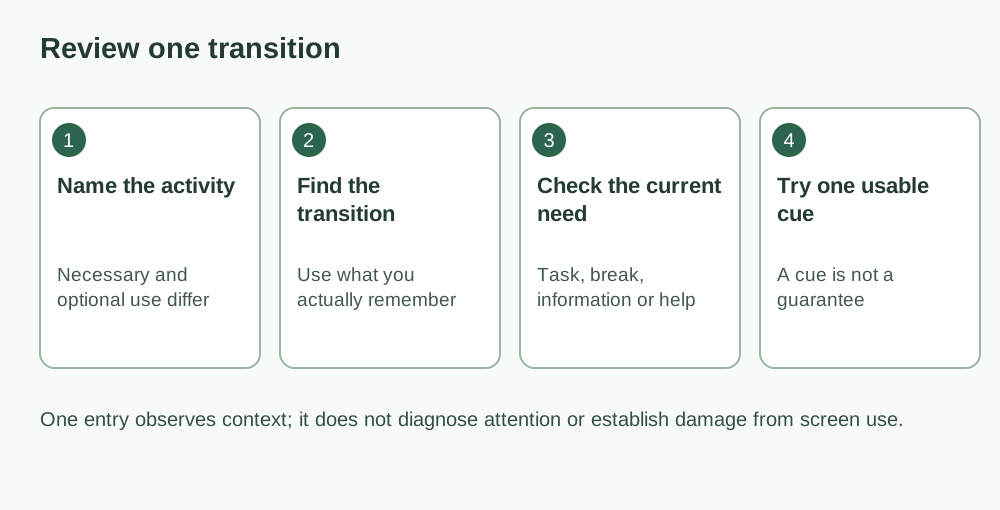
View or download the original diagram (SVG) · Download the editable record (TXT)
ACTIVITY / MATERIAL I SCROLLED:
PURPOSE I REMEMBER / UNSURE:
FIRST OPTIONAL CONTINUATION I REMEMBER:
WHAT NEEDS ATTENTION NOW:
OBSERVABLE SETUP / NECESSARY COMMUNICATION:
ONE POSSIBLE STOPPING CUE OR ARRANGEMENT:
WHAT ACTUALLY HAPPENED / STILL UNKNOWN:
NO SCREEN-TIME SCORE OR CAUSE IS INFERRED.
Sources and further reading
- WHO: Stress — questions and answers — Stress responses vary and may include difficulty concentrating. General coping and connection guidance does not determine the cause of an individual experience or validate this worksheet.
- NIMH: Caring for Your Mental Health — Emotional and practical support, individual self-care choices and qualified help for severe or distressing persistent symptoms. Its US crisis contacts are not worldwide services.