Support Request Note: Ask for the Help You Actually Need
A support request names the relevant situation, the kind of help you want and a practical way to respond. You can draft it first or speak directly. You do not need a perfect explanation, a complete journal or a finished self-awareness exercise before asking for help.
Revised
Distinguish listening, practical help and professional advice
Start with what you need from the recipient. “Could you listen for a few minutes?” differs from “Could you help me find the missing document?” and “I would like an appointment to discuss symptoms.” A clear request gives them something they can consider without making them guess the whole problem.
A friend may offer emotional support or practical assistance. They are not automatically a clinician, legal adviser or emergency service. Choose the person or service by the actual need, rather than because they are the first contact in your phone.
WHO and NIMH describe connection with trusted people and appropriate health-care support. This page offers original wording examples for an ordinary request. It does not determine the seriousness or cause of a problem, provide live support or guarantee another person’s availability.
Use four parts and omit what is unnecessary
| Part | Question to answer | Optional wording |
|---|---|---|
| Relevant situation | What does this person need to know? | “A conversation today left me unsettled.” |
| Specific ask | What kind of help am I requesting? | “Would you be willing to listen? I am not asking for advice yet.” |
| Practical arrangement | What format or time could work? | “Would a call later suit you, or is another time better?” |
| Limit and next step | What if they cannot help? | “If you are unavailable, I will ask someone else.” |
Use timing you can honestly offer. A request for an immediate response should be attached to an actual urgency, rather than used to obtain reassurance faster. For urgent danger, use appropriate real-time help instead of waiting for a casual message or filling in every field.
You can omit sensitive details that the recipient does not need. A health-care professional may need accurate symptoms and timing; ask which contact channel is appropriate. A support note is not a rule for shortening medical information or a formal account.
Compare three requests with different purposes
Listening after an ordinary difficult day
“I have had a difficult day and would like to talk about one part of it. Would you have time to listen later? I would prefer listening first rather than suggestions.” This names the desired response and leaves the other person free to offer a workable time or decline.
Practical help with an unclear task
“I cannot find the instruction for the attachment. Could you show me where the approved version is kept? I can continue once I have that.” The ask concerns a particular missing item, rather than asking somebody to take over everything.
A professional conversation
“I would like an appointment to discuss difficulties that are affecting my usual activities. Please let me know what information is useful and how to arrange a suitable appointment.” Add the facts the service actually requests. This wording neither diagnoses the problem nor makes a scheduled appointment an emergency response.
These are invented examples, not proven scripts. Use your normal language and the actual relationship. A short direct sentence is often enough to begin; you can clarify the request in the conversation.
Choose a suitable person and a safe way to contact them
Consider willingness, role, access and the circumstances. Someone who has previously respected your limits may be a useful person to ask. Someone involved in intimidation or harm may not be a suitable recipient just because they are close to you. This general note cannot provide a personal safety plan.
A recipient may be unavailable or not able to provide the requested help. That response does not establish that your need is invalid. Depending on the need, you can ask another trusted person, contact an appropriate service or obtain qualified help. Do not repeatedly pressure one person to provide something outside their role.
Before attaching a journal or screenshot, review the exact information. The privacy guide explains why changing names does not ensure anonymity. You can request support without sending the full record or another person’s private disclosure.
Try four request checks
These situations are invented to practise the distinctions on this page. They are not reports of results or a test of a person.
You want someone to listen, but the draft says “Tell me what to do.” What should change?
Name the response you actually want: listening first, practical help or advice. The recipient can then decide whether they can provide that kind of help.
A friend cannot reply today. Does that prove you should stop seeking support?
No. Availability is not a verdict on your need. Consider another suitable person or service based on the actual situation.
The request includes a full screenshot of somebody else’s private conversation. Is it necessary?
Often a short description of your experience is sufficient. Review the recipient’s purpose and omit unnecessary third-party details; formal or clinical needs may differ.
You feel unsafe or need immediate assistance. Should the note be polished before contacting help?
No. Use appropriate real-time support or emergency help for your location. A writing template and a casual recipient cannot replace an urgent response.
Finish with an actual contact choice
Read the request once: is the ask clear, is the recipient suitable, and is the proposed arrangement realistic? You can keep it as preparation, change it into spoken wording or decide to contact a service directly. Drafting does not send it, book anything or create a reminder.
If concerns are persistent or interfering with daily life, appropriate qualified support may be useful. NIMH’s two-week description for severe or distressing symptoms is not an instruction to wait when help is needed sooner. In the United States, its page directs people in crisis to call or text 988 and life-threatening emergencies to 911; elsewhere, use the appropriate local services.
Writing the request prepares you to contact a real person or service. Choose whom to contact and what you are asking for, rather than producing another private paragraph.
Use the original diagram and optional record
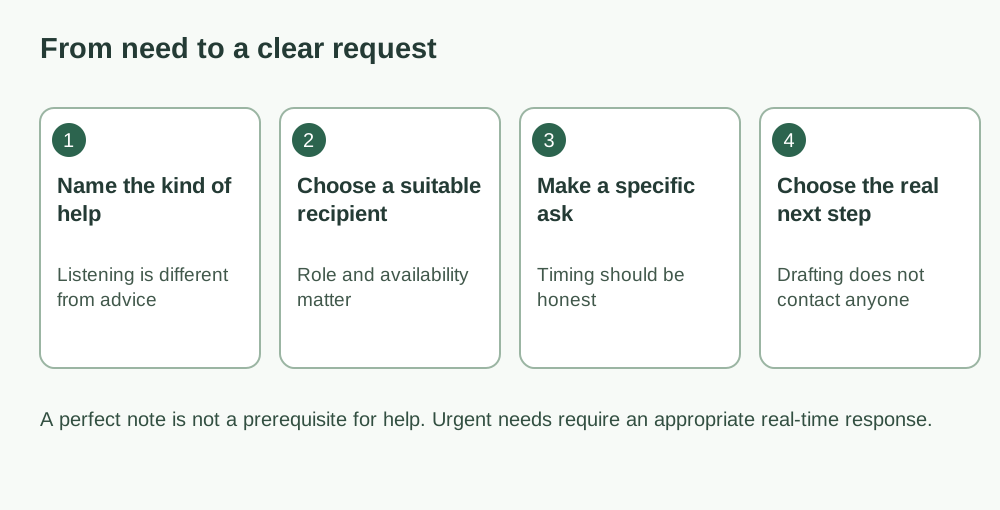
View or download the original diagram (SVG) · Download the editable record (TXT)
HELP I WANT: LISTENING / PRACTICAL HELP / PROFESSIONAL ADVICE / OTHER
SUITABLE RECIPIENT OR SERVICE:
RELEVANT SITUATION, WITHOUT UNNECESSARY DETAIL:
SPECIFIC ASK:
REALISTIC FORMAT OR TIME:
WHAT I WILL DO IF THEY ARE UNAVAILABLE:
EXACT COPY / CHANNEL TO CHECK:
DRAFT ONLY / SPEAK / CONTACT THE SERVICE:
URGENT NEEDS USE APPROPRIATE REAL-TIME HELP.
Sources and further reading
- NIMH: Caring for Your Mental Health — Emotional and practical support, individual self-care choices and qualified help for severe or distressing persistent symptoms. Its US crisis contacts are not worldwide services.
- WHO: Stress — questions and answers — Stress responses vary and may include difficulty concentrating. General coping and connection guidance does not determine the cause of an individual experience or validate this worksheet.