Practical guide
Mindful Task Switching Before and After Meetings
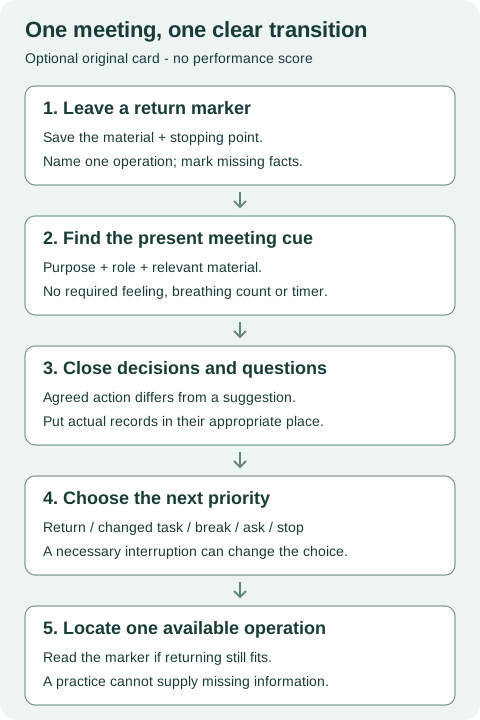
Save the stopping point before switching to the meeting. Use its actual purpose and material as entry cues, distinguish confirmed actions from open questions at the end, then choose a feasible return, changed priority, break or request for information. The original cards have no calmness threshold or measured performance promise.
Start with one actual change of task
Before leaving a task for a meeting, save its usable stopping point and one next operation. When the meeting ends, distinguish what was confirmed from what remains open, then choose which task actually needs attention next. A brief transition record can make these choices visible without requiring a completely quiet mind.
This is an original planning and attention exercise for ordinary meetings, classes or shared-project conversations. It is not a diagnostic test, treatment protocol or measured way to recover a percentage of productive time. No fixed duration or feeling of calm is required before joining.
The American Psychological Association’s public explanation of task switching describes time costs in laboratory tasks and notes that preparation reduced but did not eliminate costs in cited experiments. Those findings do not validate this particular card, supply a meeting-specific time saving or establish that every interruption should be avoided.
The NHS describes noticing present thoughts and returning attention, while noting that mindfulness can be unhelpful or make some people feel worse. Use an accessible cue in the task or surroundings. You can skip any attention exercise and still leave a useful document marker.
Pick one real transition rather than redesigning your entire working day. The question is concrete: what am I leaving, what does this meeting need, and where should I go afterwards? The answer can include rest, clarification or a changed priority.
Before the meeting, leave the unfinished task easy to find
Save the current material using its normal process. Then record the last completed point and one next operation. “Continue the report” is broad; “open the draft at Costs and check the two figures” identifies both a place and an action.
Keep a missing fact separate from a next action you can already do. If a paragraph depends on a figure that has not arrived, write the missing item and where it should come from. A return-to-task marker cannot provide information that the work lacks.
Use the task’s appropriate location for operational records. A personal mindfulness note is not a substitute for an official project record, a required decision log or an agreed communication. Follow the recordkeeping and access arrangements that actually apply.
UNFINISHED TASK - MINIMAL RETURN MARKER
Task reference:
Last completed point:
One next operation:
Missing information / unresolved step:
Where the material and note belong:
If time is short, the stopping point and next operation can be enough. Do not delay a necessary meeting or urgent responsibility to complete all five fields. Avoid copying private client, student or colleague details into a casual note merely to make it look complete.
This record concerns an unfinished task. For a personal thought you do not intend to solve now, the thought-parking prompt serves a different purpose. A thought is not automatically an assigned project action.
Use an entry check that points to the meeting itself
Bring attention to the present meeting: its purpose, your role, the material and the current question. These are practical entry cues. They do not require changing how you breathe, closing your eyes or explaining your private emotional state to other participants.
| Cue | Notice | If it is unclear |
|---|---|---|
| Purpose | What this meeting is intended to decide, explain or coordinate. | A vague title may need one clarifying question. |
| Role | What you are expected or able to contribute. | Listening, asking and taking an agreed note are different roles. |
| Material | The relevant agenda, document or accessible equivalent. | Do not collect unrelated material while the discussion is starting. |
| Current cue | The person speaking, current question or agenda item. | A difficult thought may remain present; no calmness threshold is required. |
You may notice an urge to finish the previous task while another person is speaking. If it is an optional action, use the saved return marker rather than trying to carry out both complex tasks together. Keep necessary communication or accessibility supports available; an interruption can be a real responsibility.
If you join late or lose the thread, ask for the current item or the question being considered. Do not invent a conclusion from a fragment. It is reasonable to state what you missed and clarify the material needed to participate.
A brief optional pause can use a visible object or the words on the agenda as an attention cue. Skip or change an exercise that adds distress or pressure. The entry check is a way to orient to the task, not a test of how calm or mindful you appear.
During the meeting, separate decisions from suggestions
When notes are part of your role, separate a confirmed decision, an agreed action and an unresolved suggestion. “We might revise section two” is not the same as “I agreed to revise section two before the next review.” A private interpretation cannot create another person’s commitment.
Check the owner, timing and scope of an action using the meeting’s normal process. Leave a detail marked unconfirmed if it was not settled. Do not guess an owner or deadline merely to produce a neat exit card.
If you missed a statement while thinking about the previous task, ask for clarification or consult the appropriate agreed record. Writing a confident-looking sentence does not make it accurate. The purpose of the note is to recover the actual next step.
Keep personal observations separate from shared meeting records. “I noticed an urge to reply quickly” may belong in an optional personal reflection; it is not a description of a colleague’s motives or a meeting decision. The mindful listening exercise addresses noticing the urge to prepare a reply, rather than recording project commitments.
No rule here requires taking detailed minutes, recording the conversation or sharing personal reflections. Use the actual requirements, permissions and tools for the meeting. A minimal card helps only when it fits those arrangements.
After the meeting, close the discussion before reopening the task
Use a short exit check: what was confirmed, what is still open, where does the agreed record belong, and what needs attention now? This is a transition note, not a reconstruction of the whole conversation or an attempt to settle every uncertainty privately.
| Type | What is known | Practical close |
|---|---|---|
| Confirmed decision | A proposal was actually accepted through the meeting’s process. | Record the decision in the appropriate place; do not broaden its scope. |
| Agreed next action | Who will do what, with timing only if agreed. | Check missing ownership or timing rather than filling it in. |
| Open question | A point still needs information or a later decision. | Keep it labelled open, with a real review cue when known. |
| Next personal choice | Return, changed priority, break, ask or stop. | Choose from present conditions; returning is not compulsory. |
Save or update the appropriate work record when that is your responsibility. A downloaded practice card has not sent an update to a colleague, changed a project system or created a reminder. If another person needs information, use the actual agreed communication process.
A meeting may change the priority of the unfinished task. Check that before following the old marker automatically. If the previous draft has been superseded, record the new status in its proper place rather than treating an obsolete operation as the next obligation.
MEETING ENTRY AND EXIT - ONE ACTUAL TRANSITION
Meeting purpose / current role:
Material or question needed now:
Confirmed decision or agreed action:
Open question and review cue:
Next choice: return / changed priority / break / ask / stop
Choose an honest review cue for an unresolved point: the expected file, next class, scheduled review or reply you are waiting for. An arbitrary time written on a worksheet does not guarantee that the information will be available then.
Choose the next task using the current conditions
Find the saved material and read the return marker if the original task still needs you. Do one concrete available operation. A return can begin by locating the last heading or checking a known item; it need not begin by completing the entire project.
| Situation | Recorded information | Next choice | What it does not prove |
|---|---|---|---|
| Draft paused before a coordination meeting | Saved marker: Costs heading, next check two known figures. | No changed priority confirmed; return to that operation. | The record locates a step; no completion speed is measured. |
| Meeting ends with a missing figure | The source figure is still unconfirmed. | Ask or locate the agreed source before drafting its claim. | A breathing or attention round cannot supply the missing fact. |
| Meeting agrees a different current task | The new action and scope were confirmed. | Update the appropriate task record; leave the old draft’s status clear. | A suggestion alone would not be enough to create the new assignment. |
| There is no workable return interval now | Another actual responsibility or a need for rest remains. | Keep a minimal marker and choose the feasible next responsibility or break. | The card does not require immediate return or ignoring somebody’s needs. |
These entries are invented to show how the card works. They are not observations of workers or students, a performance comparison or a claim that the method prevents mistakes. Each conclusion stays attached to its stated conditions.
For an unexpected distraction rather than a planned meeting transition, the brief task-return card focuses on locating the activity and resuming one operation. You do not need to complete both exercises before acting.
If neither task can proceed, name the obstacle: missing information, inaccessible material, conflicting instructions or an interval too short for the next step. Address that condition, clarify it or stop. Repeating a practice cannot replace a necessary arrangement or another person’s decision.
Keep the note useful, appropriately placed and optional
Use one record for one transition when it helps. There is no daily streak, distraction tally or rating of mental performance. A record can be incomplete and still point to the next usable task; uncertainty should be visible instead of concealed by a score.
Minimize personal and third-party information. Use a neutral task reference or document heading where that is sufficient. A note with no name can still reveal sensitive information through its details or storage location. Follow the actual privacy, recordkeeping and sharing arrangements for the task.
Download the plain-text entry, exit and unfinished-task cards, or use the written steps without making a record. The download supplies a file; it does not store your entries on this page or establish how another app will handle the file.
If attention exercises increase distress, discomfort or self-criticism, stop or choose a different approach. Persistent difficulties affecting ordinary responsibilities can be discussed with an appropriate qualified professional. This worksheet cannot assess their cause or replace needed support.
A workday closing prompt is a separate reflection at the end of a period of work. It does not need to be added after every meeting, and a personal reflection does not solve the surrounding workload or workplace conditions.
Six checks before treating a meeting note as a result
Try these fictional interpretation cases, then expand the explanations. They test the boundaries of the cards rather than measuring concentration or productivity.
Case 1
You have thirty seconds before joining. Must all five unfinished-task fields be completed?
Show answer and explanation for case 1
No. Save the actual work and leave a minimal stopping point or next operation if practical.
The template is optional. It should not delay a necessary meeting or urgent responsibility.
Case 2
Your note says “They might want me to rewrite everything.” Has a new assignment been confirmed?
Show answer and explanation for case 2
No. It records an interpretation or suggestion, not an agreed action.
Clarify actual scope and ownership through the meeting’s normal process; do not invent a commitment.
Case 3
The meeting ends but a figure needed for the draft is still missing. What should the next operation address?
Show answer and explanation for case 3
Find or request the agreed source information.
Repeating an attention exercise cannot produce a missing fact or validate an unsupported sentence.
Case 4
You still feel worried as the meeting starts. Does the entry card require waiting until you feel calm?
Show answer and explanation for case 4
No. Use the present purpose, material or speaker as an accessible cue, or skip the exercise.
The card has no emotional pass mark; change or stop a practice that increases distress.
Case 5
A necessary responsibility interrupts the return to your draft. Has the transition card failed?
Show answer and explanation for case 5
No. Respond to the actual need and keep a small return marker if useful.
The next choice depends on present conditions, not a rule that the original task always takes priority.
Case 6
APA discusses task-switching costs and quotes a possible productive-time percentage. May this card promise to recover that percentage?
Show answer and explanation for case 6
No. The cited research and quote do not measure this original meeting worksheet.
The examples are fictional. Record actual next steps without inventing time savings, clinical outcomes or performance guarantees.
Sources and further reading
- NHS: Mindfulness (reviewed 17 August 2026)Complete current introduction read. Present-moment attention and returning to an activity; qualification that mindfulness can be unhelpful or make people feel worse. Not validation of this original meeting card.
- APA: Multitasking - Switching costs (2006 public research summary)Complete rendered browser document read; HTTP status not observed. Cited laboratory task-switching findings and preparation limits provide context. The cited papers were not opened, and its quoted percentage is not an outcome of this worksheet.