Relationship Reflection Prompt: Review One Interaction
Review one interaction rather than deciding what an entire relationship means. Write what happened, what you noticed, what remains unknown and what you can reasonably do next. A question, a boundary or leaving the matter open can be a complete outcome.
Revised
Pick one interaction and its purpose
Choose an ordinary conversation, invitation or shared task. Decide what the reflection is for: remembering a useful moment, clarifying an unanswered question, reviewing your own response or preparing a suitable conversation.
“We ended the call without deciding the visit date” gives a starting point. “Our relationship never works” is a broader conclusion that one entry cannot establish. If you are reviewing a pattern, begin with an actual example rather than constructing the pattern from assumptions.
A personal journal does not assess compatibility, diagnose the other person or decide whether a relationship should continue. A situation involving harm, coercion or safety may need appropriate human support rather than a private reflection or an invitation to reconcile.
Keep the event, experience and unknowns visible
| Line | Invented example | What remains separate |
|---|---|---|
| Event | “They said they could not visit this weekend.” | Their stated availability, rather than a guessed reason. |
| My experience | “I felt disappointed and wanted to ask again.” | Feeling and urge; neither decides their obligation. |
| Interpretation | “I wondered whether spending time together mattered to them.” | A thought to label, not a confirmed motive. |
| Known information | “They suggested another weekend.” | An actual suggestion, not a promise unless agreed. |
| Possible next step | “Ask whether one of the other dates suits both of us.” | An invitation they can decline. |
The example is not advice to reinterpret every refusal positively. If a person says no, respect the answer. If a repeated conduct causes concern, keep accurate examples and consider suitable support. A feeling can be valid while the explanation linked to it remains uncertain.
Review what you did without taking responsibility for everything
Write an action you actually took: asked a question, interrupted, agreed, said no, left or offered assistance. Consider its effect using known information. “They asked me to stop interrupting” is feedback you can use. “I made them feel rejected” may be an interpretation unless they told you that.
A specific mistake can call for a specific repair. “I interrupted when you were explaining the date; I am sorry. Would you like to finish?” acknowledges an action. A long statement about being a terrible person can take the focus away from the effect of the interruption.
Reviewing your conduct does not assign you responsibility for someone else’s choices or require shared blame. Nor does the prompt establish that apologising will repair a situation or that another person owes forgiveness. Keep their response and willingness outside what you can control.
Choose a question, boundary or ordinary next step
If information is missing, make the question specific: “Was the later time a suggestion or an agreement?” If a request is unavailable, state your limit honestly: “I cannot take that on this week.” If the interaction needs no further action, you can close the entry.
Before a conversation, consider whether it is appropriate and wanted. Do not turn a journal question into a demand that the other person explain their feelings, accept your interpretation or participate in a timed exercise. The paired listening practice describes a different, voluntary activity with a willing partner.
For post-disagreement conduct and consequences, use the conflict reaction review. For the order of events and uncertain gaps, use the reaction timeline. You do not need all three records for one interaction.
Try four reflection checks
These situations are invented to practise the distinctions on this page. They are not reports of results or a test of a person.
Someone declines a visit. Can the note state that they do not care?
Not from that fact alone. Record the declined plan and your feelings; their reasons may be unknown. Respect the refusal without treating it as a test you must reverse.
You interrupted twice. Must your entry judge your whole character?
No. Record the action, any known feedback and a specific repair you can consider. Keep responsibility concrete.
Your reflection suggests a conversation, but the other person does not want it. Is another invitation required?
No. A prompt does not create consent or an obligation to talk. Respect the boundary and consider other suitable ways to handle the actual concern.
The interaction involves intimidation. Should the exercise focus on finding your share of the blame?
No. It cannot allocate blame or provide a safety plan. Prioritise appropriate support and safety rather than forcing mutual responsibility or reconciliation.
Keep a personal observation, not a dossier
Use a brief description sufficient for your purpose. Avoid saving unnecessary messages, diagnoses or private disclosures about the other person. The journal privacy guide distinguishes a personal note from a record needed for formal evidence or professional support.
The NHS thought-reframing guidance notes that changing thoughts is not compulsory and does not solve every problem. You can leave an interpretation unresolved while asking for a practical detail or setting a boundary. Reflection does not require making every interaction feel better.
Stop if the note becomes repetitive or increases distress. Persistent concerns that affect daily life, or a situation that needs safety or professional guidance, may require human help. Finish with one honest observation and an appropriate next choice, including doing nothing further for now.
Use the original diagram and optional record
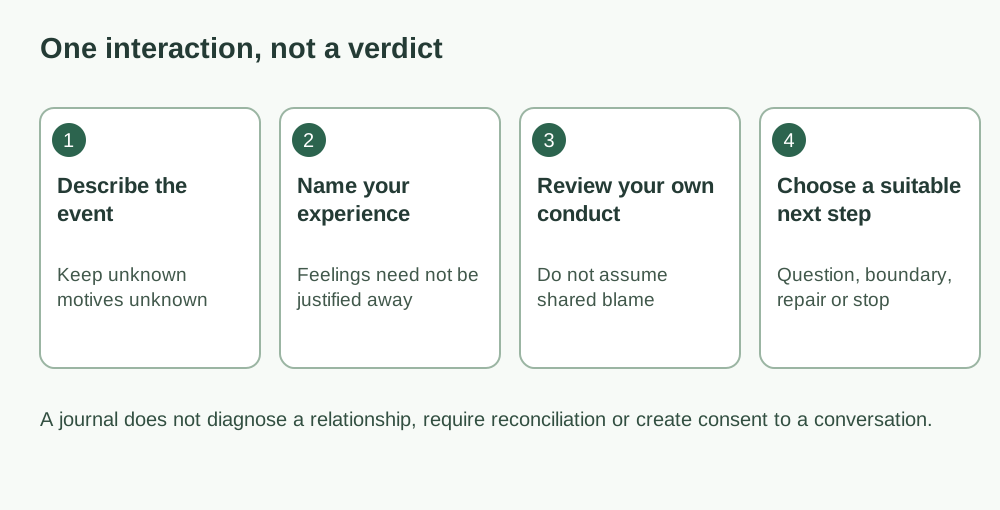
View or download the original diagram (SVG) · Download the editable record (TXT)
PURPOSE OF THIS REFLECTION:
ONE INTERACTION I AM REVIEWING:
WHAT ACTUALLY HAPPENED / WORDING I KNOW:
MY FEELING / URGE, IF USEFUL:
INTERPRETATION, LABELLED AS A THOUGHT:
MY ACTUAL ACTION / KNOWN EFFECT:
UNKNOWN INFORMATION:
QUESTION / BOUNDARY / REPAIR / STOP:
OTHER PERSON’S WISHES OR RESPONSE REMAIN THEIR CHOICE.
Sources and further reading
- NHS Every Mind Matters: Reframing unhelpful thoughts — Thoughts, feelings and behaviour can influence one another. Checking evidence and alternatives need not deny a real problem; changing every thought is not required. This guide does not reproduce a clinical CBT protocol.
- NHS: Mindfulness — Present-moment awareness, naming thoughts and feelings, gently returning attention, and the qualification that mindfulness may be unhelpful or make some people feel worse. This original exercise is not a mindfulness-based therapy.
- NIMH: Caring for Your Mental Health — Emotional and practical support, individual self-care choices and qualified help for severe or distressing persistent symptoms. Its US crisis contacts are not worldwide services.